Exploring the World of AI Compilers: Powering AI Compute and Inference
February 20, 2025 · 12 min read
Introduction
Artificial Intelligence (AI) is transforming industries, from autonomous vehicles to personalized streaming. But behind the scenes, AI compilers are the unsung heroes making these models run faster and smarter on diverse hardware.
Whether you're deploying a large language model on a GPU or optimizing a neural network for an edge device, AI compilers bridge the gap between high-level models and hardware-specific performance.
In this blog, we'll explore the exciting world of AI compilers, from NVIDIA TensorRT to OpenAI Triton.
What Are AI Compilers?
AI compilers take machine learning models — built in frameworks like PyTorch, TensorFlow, or JAX — and transform them into optimised, hardware-specific code.
They act like translators: turning abstract algorithms into instructions your GPU, CPU, or specialised accelerator can execute efficiently.
They employ techniques such as:
- Quantisation
- Kernel fusion
- Graph optimisation
…all to reduce latency and increase throughput for real-time AI applications.
Why It Matters
Whether you're a developer building autonomous systems or a data scientist deploying models on edge devices, AI compilers are key to unlocking performance.
Top AI Compilers You Should Know
1. NVIDIA TensorRT: The GPU Inference Powerhouse
- Advanced quantization (FP8, INT4, AWQ) for compact, fast models
- Optimized for CUDA-enabled NVIDIA GPUs
- Used by Amazon, Netflix, and Zoox
- Community: 11.7k+ stars on GitHub
Why It's Cool: TensorRT minimizes memory bandwidth — perfect for self-driving cars and medical devices.
2. Apache TVM: The Universal Optimizer
- Optimises computations for CPUs, GPUs, and ML accelerators
- Strong open-source community (12.3k+ stars on GitHub)
- Used by Alibaba, AWS, Intel
Why It's Cool: Hardware-agnostic design makes TVM ideal for cross-platform AI deployment.
3. XLA (Accelerated Linear Algebra): Google's Optimization Engine
- Optimizes TensorFlow, JAX, and PyTorch models
- Linear algebra optimizations for performance
- Open-source (5.3k+ stars on GitHub)
Why It's Cool: XLA powers Google's massive AI workloads.
4. ONNX Runtime: Microsoft's Cross-Platform Champion
- Supports training + inference
- Runs on Windows, Linux, Mac, iOS, Android, Web
- 16.8k+ stars on GitHub
Why It's Cool: Its cross-platform reach makes it perfect for developers everywhere.
5. Glow: Meta's Accelerator-Friendly Compiler
- Focused on accelerators, CPUs, and GPUs
- Kernel fusion optimizations
- 3.3k+ stars on GitHub
Why It's Cool: Tailored for accelerators, Glow is great for cutting-edge AI hardware.
6. nvFuser (PyTorch): NVIDIA's JIT Compiler
- Generates fast fusion kernels for NVIDIA GPUs
- Just-in-time compilation
- Open-source
Why It's Cool: Delivers runtime performance boosts for PyTorch users.
7. PlaidML: Intel's Portable Tensor Compiler
- Supports Keras, ONNX, nGraph
- Targets NVIDIA, AMD, Intel hardware
- 4.6k+ stars
Why It's Cool: Democratizes AI for devices with limited support.
8. OpenVINO: Intel's Edge AI Toolkit
- Optimized for Intel hardware
- Supports generative + conventional AI models
- 8.4k+ stars
Why It's Cool: Powers smart cameras and IoT devices.
9. IREE: Scaling from Data Centers to Edge
- MLIR-based, supports PyTorch, ONNX, JAX, TF
- Scales from GPU to edge accelerators
- 3.2k+ stars
Why It's Cool: Unified approach simplifies multi-device deployment.
10. MLC-LLM: Optimizing Large Language Models
- Native deployment across GPUs, CPUs, accelerators
- Open-source
- Exposes OpenAI-compatible APIs
Why It's Cool: Brings LLM inference to any hardware platform.
11. Triton: OpenAI's GPU Programming Simplified
- Python-like language for GPU kernels
- LLVM-powered backend
- Open-source
Why It's Cool: Lets non-CUDA experts write high-performance GPU code.
12. SHARK-Studio: IREE's Community Experiment
- Experimental MLIR project
- Open-source, but not actively maintained
Note: A glimpse into experimental compiler ideas.
13. Hidet: Python-Powered Inference
- PyTorch + ONNX support
- CUDA 11.6+, Linux only
- 700+ stars
Why It's Cool: A Python-first compiler for NVIDIA GPUs.
14. PolyBlocks: The A100 Speedster
- MLIR-based, targeting NVIDIA GPUs
- Reportedly faster than CuBLAS/TensorRT
Note: Promises huge performance, but closed-source.
15. Mojo: Pythonic Power Without CUDA
- Targets CPUs + GPUs without CUDA dependency
- Backed by Modular (MAX)
- Closed-source
Why It's Cool: Pythonic simplicity with blazing speed.
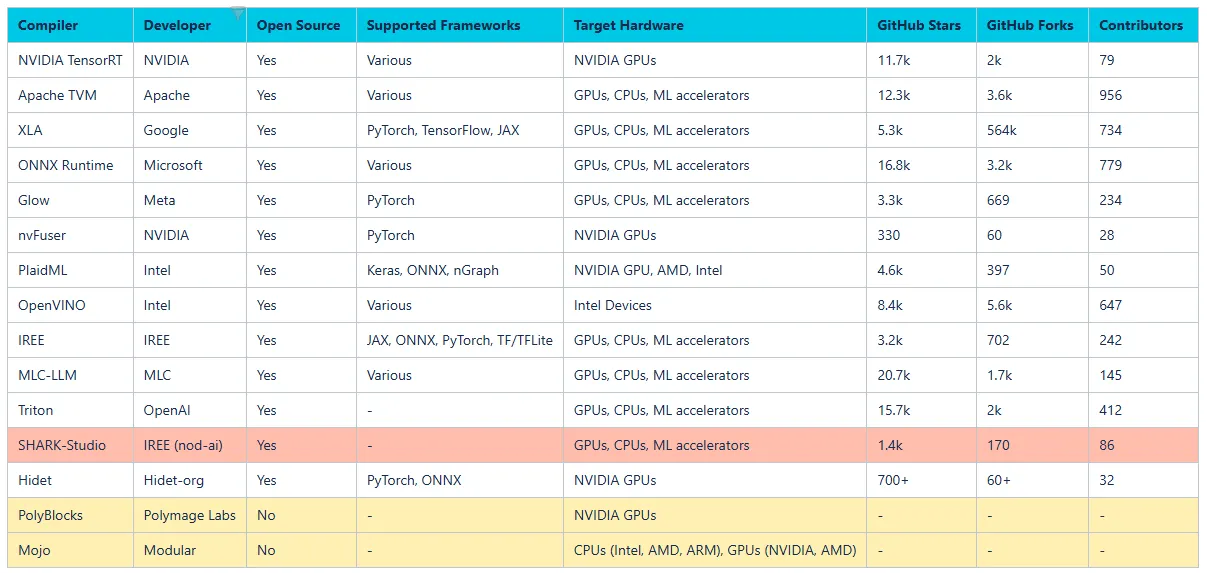
Comparison Table
Wrapping Up
AI compilers are the invisible engines powering today's AI revolution — from LLMs in the cloud to edge inference on IoT devices. Choosing the right one depends on your hardware, framework, and performance needs.